People ops · 2026
Best AI tools for HR and hiring (2026)
Coordinators, talent graphs, and job-post editors — ranked for talent teams that hire enough to feel the pain, not for a chatbot pitch deck.
Gregory Greenstein, Aiacent
- Published
- Updated
- Pricing verified
- How we rank
Most 'AI for HR' marketing is a résumé parser in a new hoodie. We ranked this category by a meaner test: does the product take a real load off a recruiter, a coordinator, or a hiring manager — without inventing policy or quietly discriminating at scale.
The 2026 short list is still narrow on purpose. Paradox wins high-volume, hourly hiring. Eightfold is the enterprise talent graph. Textio is the job-post editor that is still worth a dedicated seat. If a vendor cannot say which of those jobs they do, they are not on this page.
We did not add a fourth 'platform' just to look comprehensive. The useful buying decision is which job is leaking — candidate communication, internal mobility, or the language of the req — and then funding that job.
Who this ranking is for. Talent acquisition, HR ops, and people leaders at companies that hire enough to feel the pain — stores, clinics, warehouses, and large internal-mobility orgs. Not a shopping list for a 12-person startup that needed a better LinkedIn post.
At a glance
Scores are editorial, out of 10. Jump to a write-up, or open the full tool review for pricing detail and the longer verdict.
| Rank | Tool | Score | Best for | Skip if | From | Review |
|---|---|---|---|---|---|---|
| 01 | Paradox | 8.7/10 | Retail, hospitality, healthcare, and logistics teams hiring at scale. | You hire twenty specialists a year and already have a thoughtful recruiter. | Enterprise quote — expect a real implementation | Full review |
| 02 | Eightfold AI | 8.2/10 | Large employers that want internal mobility and smarter matching, not just inbound apply. | You do not have a talent data problem — you have a sourcing-capacity problem. | Enterprise platform pricing | Full review |
| 03 | Textio | 8.0/10 | TA and employer-brand teams that write a lot of job posts and career-site copy. | You post three roles a year on LinkedIn and call it a talent strategy. | SaaS subscription, typically mid-market and up | Full review |
Paradox
8.7/10Best for high-volume hiring
Conversational hiring for high-volume roles.
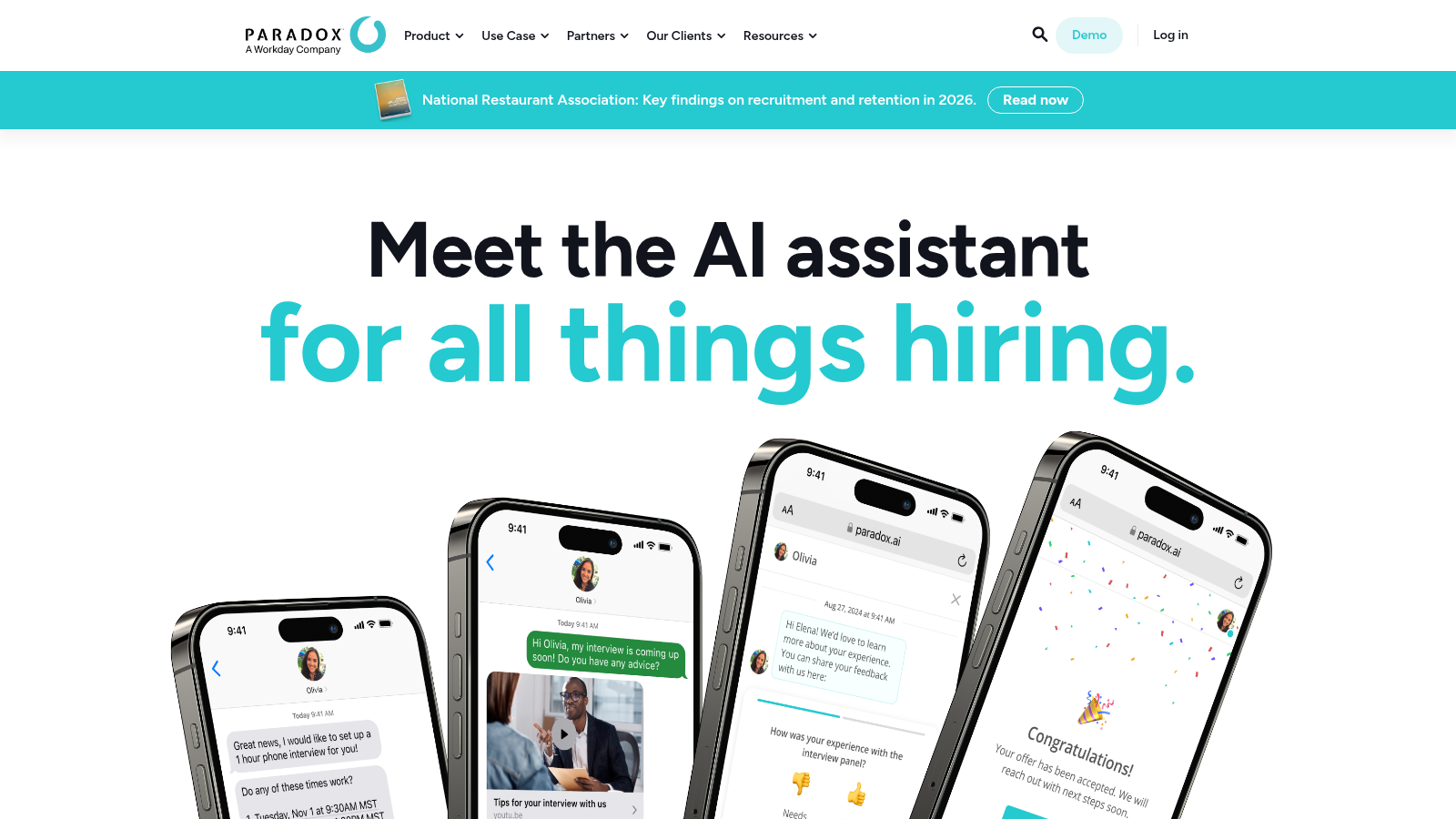
Paradox's assistant, Olivia, is one of the few HR 'AI' products that replaces a real pile of work: answering 'what's the pay range,' booking interviews, and keeping hourly candidates from dropping off because nobody texted them back.
- Best for
- Retail, hospitality, healthcare, and logistics teams hiring at scale.
- Skip if
- You hire twenty specialists a year and already have a thoughtful recruiter.
Why it ranks
- Olivia (the assistant) actually texts candidates like a coordinator would
- Scheduling, screening, and FAQs take a brutal amount of recruiter time off the table
- Built for hourly and frontline hiring, not bolted on later
Watch-outs
- You will implement it like software, not like a Chrome extension
- Overkill for specialist / exec search
- Conversational AI still needs a human on edge cases and legal review
Eightfold AI
8.2/10Best talent intelligence
Talent intelligence for enterprises that already have the data.
Eightfold is talent intelligence: matching, internal mobility, and a skills graph that tries to see people as more than the last job title they typed into Workday. It is one of the few HR AI platforms that is not pretending to be a chatbot.
- Best for
- Large employers that want internal mobility and smarter matching, not just inbound apply.
- Skip if
- You do not have a talent data problem — you have a sourcing-capacity problem.
Why it ranks
- Skills graph is more interesting than keyword matching
- Internal mobility is a first-class use case, not a slide
- Serious product for global talent orgs
Watch-outs
- Heavy. Implementation is a program, not a login.
- Smaller TA teams will not use half of it
- Model quality still depends on the messiness of your HRIS data
Product look · figure pending
Eightfold AI
Best for. Large employers that want internal mobility and smarter matching, not just inbound apply.
Skip if. You do not have a talent data problem — you have a sourcing-capacity problem.
No vendor screenshot until a rights-cleared file exists at public/figures/eightfold.png. We do not hotlink app UIs.
Textio
8.0/10Best job-post writing
The job-post editor that pays for itself in applicant quality.
Textio is not trying to be your ATS. It scores and rewrites recruiting copy so more of the right people apply. That sounds small until you have watched a 'ninja rockstar' post quietly filter out half the market.
- Best for
- TA and employer-brand teams that write a lot of job posts and career-site copy.
- Skip if
- You post three roles a year on LinkedIn and call it a talent strategy.
Why it ranks
- Specific, evidence-backed guidance — not 'make it more engaging'
- Catches gendered and exclusionary phrasing recruiters are numb to
- Lightweight compared with a full talent-intelligence suite
Watch-outs
- Narrow: it will not source, screen, or schedule
- Guidance can feel preachy if your culture is 'post and pray'
- You still need a human who knows the role
Product look · figure pending
Textio
Best for. TA and employer-brand teams that write a lot of job posts and career-site copy.
Skip if. You post three roles a year on LinkedIn and call it a talent strategy.
No vendor screenshot until a rights-cleared file exists at public/figures/textio.png. We do not hotlink app UIs.
The three jobs HR buyers keep mixing up
Open a 2026 HR RFP and 'AI' appears in every line. That word is doing three unrelated jobs. Mixing them up is how you spend a year implementing the wrong system — and then blaming the model.
- Conversation and coordination (Paradox): text the candidate, ask the knockout questions, book the slot, answer what it pays. Close to a coordinator. Not talent intelligence.
- Matching and mobility (Eightfold): a skills graph, internal fill, a less dumb ranking of inbound. Assumes data, an owner, and patience. Will not text a candidate at 9pm.
- Language (Textio): the words you already ship — job posts, career-site copy, outreach. Cheap compared with a platform. Useless if the leak is further down the funnel.
Who should buy what in 2026
High-volume hourly and frontline hiring
Start with Paradox. Olivia is one of the few HR products that replaces a real pile of work: pay-range FAQs, interview booking, and the drop-off that happens when nobody texts back. Retail, hospitality, healthcare, and logistics teams will recognize the math immediately. Specialist / exec search teams will not. Budget for ATS integration and a real implementation — this is not a Chrome extension.
Enterprise talent intelligence and internal mobility
Eightfold is the second-place product because the job it does — redeploying people you already pay — is more valuable than another screening widget, but only if you are big enough to have that problem. Ask for a pilot on internal fill rate, not a science-fair demo on public profiles. Mid-market teams that buy it without a people-analytics owner often invent a 'skills ontology' project they did not budget for.
Employer brand and job-post quality
Textio is the first purchase for a lot of mid-market TA teams, and it should be. Applicant quality often starts with the post. If you write a lot of reqs and career-site copy, a dedicated editor that scores inclusive language and predicts who will apply is still cheaper than a platform you will not finish implementing. If you post three roles a year on LinkedIn, skip it.
What changed for HR AI in 2026
Two things. First, regulators and plaintiffs' lawyers are less impressed by 'the model decided.' Treat ranking and knockout systems as high-risk: document them, test them, keep a human on adverse decisions. Second, the market is finally splitting into the three jobs above. The vendors still selling an 'AI recruiting platform' that is all three poorly are easier to walk away from.
We also kept the list short on purpose. LinkedIn Recruiter's AI features and ATS-native copilots (Ashby Intelligence, Greenhouse, Lever) are useful if you already pay for the ATS. They are not a reason to switch systems, and they are not a strategy. They live in honorable mentions.
A 90-day plan that does not embarrass you
- Week 1–2: name the leak with numbers. No-shows? Time-to-schedule? External fill of roles you already employ? Weak applicant quality on the same req rewritten three times?
- Week 3–6: buy the tool that matches that leak. One tool. Run it on a single job family or location, not the whole company.
- Week 7–12: read the misses with TA, HRBP, and legal in the room. Expand only if candidate experience and adverse-decision handling held up.
Hire fewer coordinators for rote work. Keep the people who can sell the role and read a room.— Aiacent HR ranking, 2026
Verdict
If you run stores, warehouses, or clinics and candidates live in SMS, Paradox is still the 2026 default. If you are a large employer measured on internal fill, Eightfold is the serious talent-intelligence bet — staff the implementation. If the embarrassing part is the job post, buy Textio first and do not apologize for starting small. Do not buy all three on the same Tuesday.
How we chose
- We scored products on time saved for a real recruiting workflow, not on demo-wow.
- Candidate experience counts: if the AI makes applying worse, it loses.
- Implementation weight is a feature, not a footnote. A tool you cannot stand up does not rank.
- We read vendor claims on bias and automation against how the product actually routes humans.
- Price honesty: if the only path is a six-month professional-services circus, that is in the score.
The longer rubric lives in how we rank. Affiliate money does not buy a row in the table.
Honorable mentions
Ashby Intelligence
Excellent if you already run Ashby. Not ranked here because it is not a standalone AI product.
LinkedIn Recruiter AI features
Use them if you pay for Recruiter. They are not a strategy, and they are not a reason to ignore Paradox or Textio.
Greenhouse and Lever copilots
Fine assistive writing and ranking inside the ATS you already own. Not a category winner.
FAQ
Ranked tools
Related guides
- What 'AI-powered' actually means in HR softwareA screening chatbot, a skills graph, and a job-post editor are three different products. HR buyers keep getting pitched all three as the same miracle.
- Paradox pricing (2026): Olivia is a quote, not a $49 chatbotParadox publishes a product, not a price. Implementation is a program. The expensive mistake is treating Olivia like Textio — or inventing a $1,000 sticker and calling it official.
- A sane AI HR / hiring stack (2026): a ladder, not a 12-logo talent OSStart with the leak you can name. Add Textio when the post is sloppy, Paradox when SMS scheduling is the pile, Gem when outbound is the motion. Skip the rest until a step is leaking.
- Is Paradox worth it in 2026? A buyer decision, not a vibe checkParadox is worth it when candidates live in SMS and you hire hourly volume a thoughtful recruiter cannot text. It is not worth it as a prettier chatbot or a $49 Textio. Olivia is a quote. Here is the split — and the skip-ifs.
- A sane AI stack for recruiters (2026): a ladder, not a 20-logo talent OSStart with the ATS you already run and the leak you can name. Add Gem when outbound is the motion. Add SeekOut when the names are missing. Add Ashby only if you will migrate. Add Paradox only when SMS scheduling is the pile. Skip the rest until a step is leaking.
- Jasper vs Copy.ai (2026): which one belongs on your team?Jasper is a brand-voice copy desk. Copy.ai is a GTM workflow engine that still writes. They are not interchangeable, and the cheaper seat is usually the wrong reason to choose.
- Jasper alternatives (2026): what to buy instead — and when Jasper still winsMost teams shopping Jasper alternatives needed a default brain, a GTM workflow, cheaper SEO volume, or enterprise locks — not a cheaper copy desk. Here is how to pick.
- Copy.ai alternatives (2026): what to buy instead — and when Copy.ai still winsMost teams shopping Copy.ai alternatives needed a brand desk, a default brain, cheaper SEO volume, a careful writer, or a better list — not a cheaper GTM workflow. Here is how to pick.
Sibling rankings
- Best AI tools for finance and accounting (2026)Invoice capture, a modern ledger, and firm automation — ranked for people who still close the books, not for a chatbot that 'does your taxes.'
- Best AI tools for customer service (2026)Agents that resolve, copilots that draft, and platforms for when support is a department — ranked for teams who will read the transcripts.
- Best AI tools for sales and outreach (2026)Gong for the call, Clay for the list, Apollo when you need a stack this week, Copy.ai when the first touch is a workflow — ranked for people who still have a number.
- Best AI tools for ecommerce (2026)Klaviyo for the customer graph, Photoroom for the catalog, Shopify Magic for the admin, Pictory when content is actually a channel — ranked for merchants who have to restock this week.
- Best AI tools for productivity (2026)Writing, meetings, and docs: Jasper for brand voice, Grammarly in every text box, Notion AI on the wiki, Otter for the call — ranked for people who will not open another general chatbot.
- Best AI transcription and meeting tools (2026)Otter for live notes, Fireflies for the searchable archive, Fathom for the free recorder, Notion AI when the notes already have to live in the wiki — ranked for people who will not write it up after.
- Best AI writing tools (2026)The dedicated copy ranking.
- Best AI tools for marketing (2026)When the copy has to live next to video and email.
- Best AI resume builders (2026)The candidate side — Teal, Rezi, Kickresume, Jobscan.
- All rankingsThe full short-list index — not a 50-tool dump.