How-to · 2026
How to brief an AI writer so the draft is usable (2026)
Six lines before you generate: reader, offer, proof, banned words, a voice sample, and what done looks like. Then pick ChatGPT, Jasper, or Anyword for that job — not all three.
Gregory Greenstein, Aiacent
- Published
- Updated
- Pricing verified
- 13 min read
- How we rank
ChatGPT
8.3/10Best default writing seat
The default brain. Still the right first writing seat for most people.
ChatGPT is the baseline every other AI writing tool has to beat. For a solo operator with a decent brief, Plus is still the correct first purchase in 2026: drafts, rewrites, outlines, and the ugly first pass on a landing page. Image generation in the same tab is a different review — ChatGPT Images on the 2026 image ranking. Claude vs ChatGPT is the two-way fight if the other tab in the meeting is Anthropic. ChatGPT vs Gemini is the two-way if the other tab is Google. Perplexity vs ChatGPT is the two-way if the other tab is a research engine. On a coding desk it is a helper tab, not an IDE — that ranking is AI coding. On an SEO desk it is a draft helper, not a content-score platform — that ranking is AI SEO.
- Best for
- Anyone who needs a strong general writer, researcher, and editor in one tab.
- Skip if
- Several people have to sound like the same company every week — that is Jasper's job.
Why it ranks
- The best generalist writer most operators will actually open
- Research, drafting, and editing in one thread beats a template farm
- Plus is cheap enough that 'should we buy a copy tool' is a real question
Watch-outs
- No shared brand voice unless you build the habit yourself
- Easy to publish confident filler if nobody owns the facts
- Not a campaign system, a sequencer, or a style-guide desk
Product look · figure pending
ChatGPT
Best for. Anyone who needs a strong general writer, researcher, and editor in one tab.
Skip if. Several people have to sound like the same company every week — that is Jasper's job.
No vendor screenshot until a rights-cleared file exists at public/figures/chatgpt.png. We do not hotlink app UIs.
Jasper
8.4/10Best for brand voice
Brand-safe marketing copy at campaign scale.
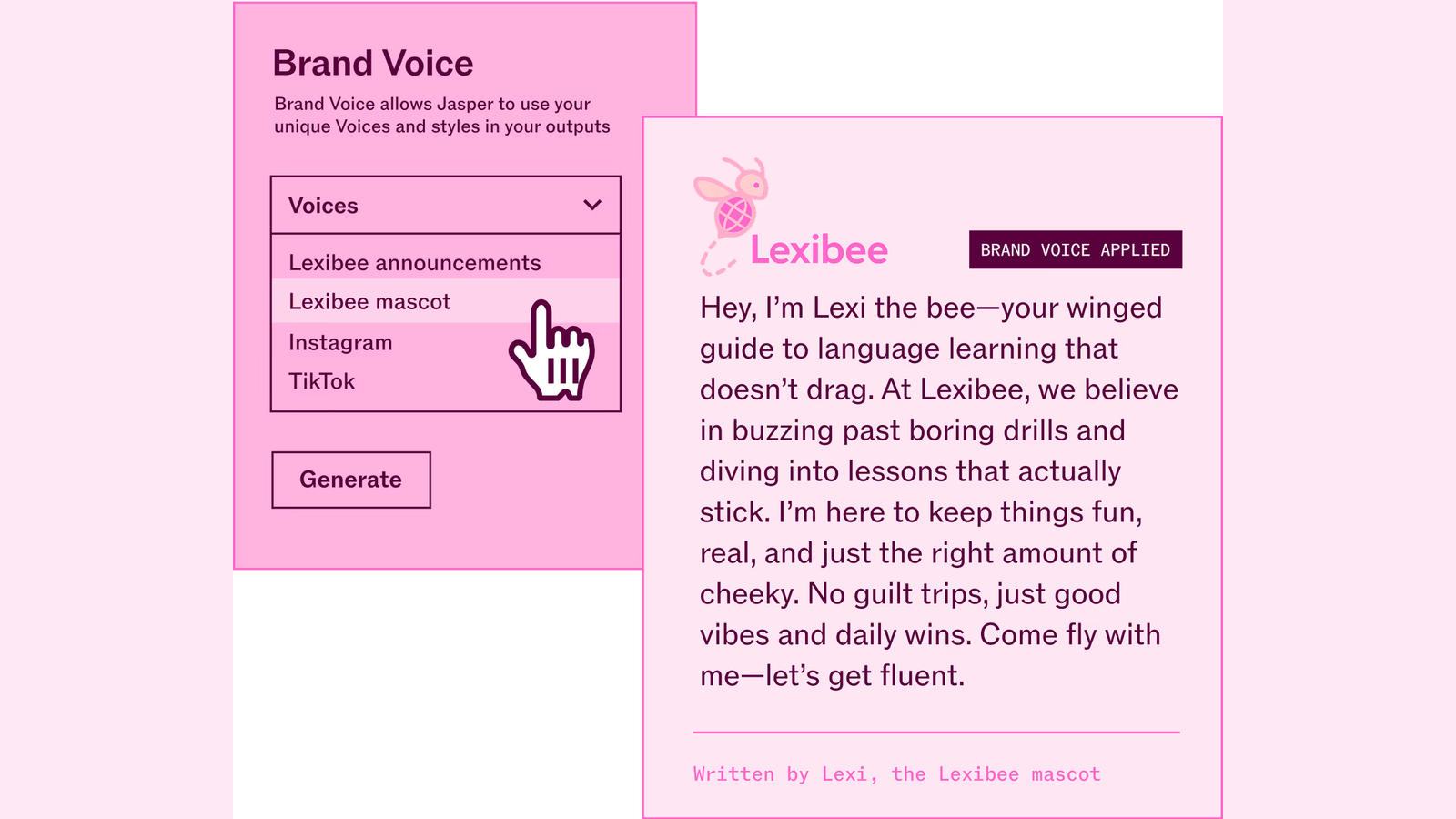
Jasper is the grown-up cousin of the 2021 copy-AI boom. It still writes ads, emails, and landing pages, but the product that matters now is the brand-voice layer: tone, forbidden phrases, product facts, and campaign briefs that keep a five-person content team from sounding like five different interns.
- Best for
- In-house marketing teams that already have a brand voice and need volume.
- Skip if
- You mainly need research, coding, or one-off drafts — ChatGPT is cheaper.
Why it ranks
- Strong brand-voice controls once you train them
- Campaign workflows beat a naked chatbot for marketing teams
- Templates for ads, landing pages, and email that non-writers can actually use
Watch-outs
- Pricey compared with ChatGPT or Claude for similar raw drafting
- Long-form can still sound samey without a tight brief
- Image and video features are extras, not the reason to buy
Anyword
7.6/10Best for scored ad copy
Performance-scored marketing copy — a prediction desk, not a brand OS.
Anyword survived the 2021 copy-AI pile-up by selling a different job: generate the variant, then score it against performance data before you spend the media. That is a real seat for a paid-social or lifecycle person who already A/Bs. It is a bad substitute for Jasper's voice card, and a worse substitute for ChatGPT Plus if you only needed a first draft.
- Best for
- Performance marketers who will actually pick the higher-scored ad or email variant.
- Skip if
- You needed a shared brand voice across a bench, or a $20 first draft.
Why it ranks
- Performance predictions are the product, not a slide next to a chatbot
- Channel templates for ads, email, and landing pages a media buyer will actually reuse
- Data-Driven's real-time score on a manual edit is a real workflow if you will look at it
Watch-outs
- A score is not a brand voice. Five people will still sound like five interns.
- No permanent free plan — the 7-day trial is a taste, not a desk
- Easy to buy Starter as a cheaper Jasper and then never open the prediction tab
Product look · figure pending
Anyword
Best for. Performance marketers who will actually pick the higher-scored ad or email variant.
Skip if. You needed a shared brand voice across a bench, or a $20 first draft.
No vendor screenshot until a rights-cleared file exists at public/figures/anyword.png. We do not hotlink app UIs.
Grammarly
8.2/10Best everywhere writing layer
The writing layer that follows you into every text box.
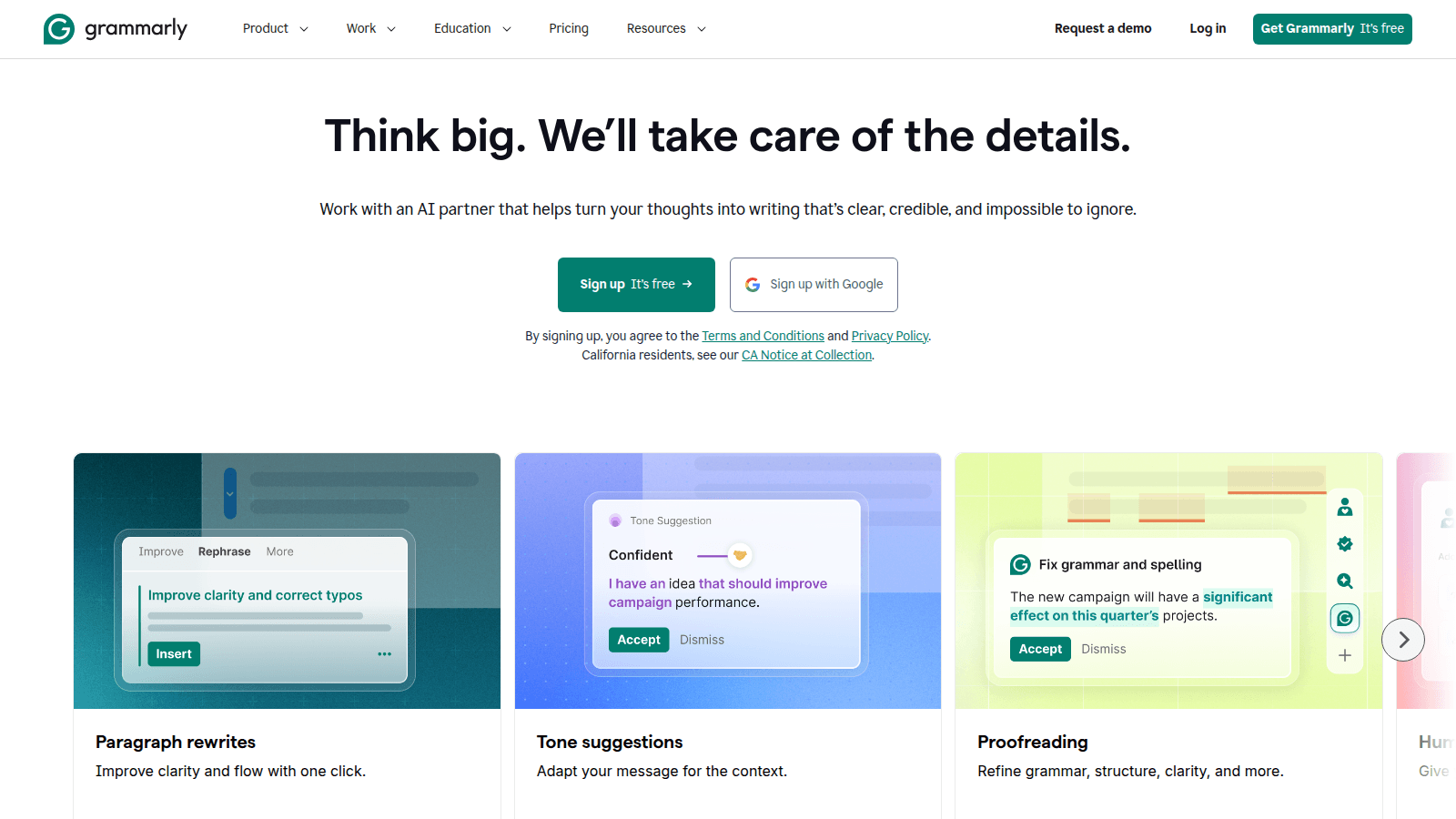
Grammarly won by living in the text box. The AI era just gave it more to do: rewrites, tone, and drafts. We rank it as the writing layer for people who will not open a dedicated copy tool. Grammarly alternatives is the decision page if you are trying not to buy it — or to keep it on purpose.
- Best for
- Anyone who writes in public — support, sales, docs, and execs included.
- Skip if
- You only write in one app that already has a great model.
Why it ranks
- It is already in the browser when you need it
- Tone and clarity suggestions are still better than most built-in checkers
- Enterprise brand tones are underrated
Watch-outs
- Generative features are 'fine,' not a reason to dump Jasper
- Can nag
- Privacy-sensitive orgs need to read the enterprise docs, not the blog
People search 'how to brief an AI writer' after the fifth generation still sounds like a landing page from 2023. The model is usually doing what it was given. A blank 'write a Facebook ad for our product' is not a brief. It is a request for the average of the internet. The usable draft starts before the generate button, in six lines a human could also hand to a freelancer.
This is a how-to for US marketers and freelance copywriters. It is not a prompt-engineering course, and it is not a claim that a format lifts conversion. We did not run that test. The copywriting ranking is the scored table — Jasper, ChatGPT, Anyword, Writesonic. Jasper vs ChatGPT is the two-way if you are choosing a seat. The writing-tool checklist is the RFP version. Read this one if the drafts are mush and you are about to buy a second writer to compensate.
Write the six lines first
Do this in the doc, not in the chat, so you can reuse it. If a line is empty, you do not have a brief yet. You have a vibe.
| Line | What to write | A weak version |
|---|---|---|
| Reader | Who they are and what they already believe | 'Small business owners' |
| Offer | The thing, the price band if it matters, the next step | 'Our innovative platform' |
| Proof | One fact you can stand behind, or an honest 'none yet' | A statistic you invented |
| Banned | Words, claims, and competitor names that cannot ship | 'Don't sound robotic' |
| Voice | A short sample of copy you would actually publish | 'Friendly and professional' |
| Done | Format, length, and the line that would make you keep it | 'Make it pop' |
Proof is the line that keeps you honest. If you do not have a number, say so in the brief. Asking the model for a 'compelling statistic' is how fake benchmarks end up on a US landing page with your logo. Voice is a paragraph you wrote, or a paragraph the client already approved. An adjective is not a voice. Done is concrete: three primary texts under 125 characters, or one hero and one subhead, not 'a campaign.'
Paste it, ask for options, then cut
Put the six lines at the top. Ask for three options, not one masterpiece. Tell it which line it is not allowed to smooth over. Then do the edit a client would notice: delete the adjective pile, restore the specific noun, check the proof against the source. If all three options are the same sentence in different hoodies, the brief is still thin. Add the missing line. Do not add a second model.
- Generate three. Keep one. Rewrite it in your own cadence.
- Read it out loud. If you would not say it on a call, it does not ship.
- Check every number against the source you pasted. If you did not paste a source, do not publish a number.
- Grammarly underneath catches the slip. It does not supply the point of view.
Pick the seat after the brief exists
ChatGPT when you are one writer and the brief is the job
Plus at $20 is the default seat for a freelancer or a marketer who will rewrite. A custom GPT can hold one client's six lines. It will not police a team that ignores it. Stay here until the failure has a name.
Jasper when several people have to sound like one company
The leak is brand review, not the blank page. Jasper Pro is roughly $59 a month on the ladder we cite. Put the voice sample and the banned list in the brand settings, then still brief the assignment. A voice card without a brief is a polite average. Is Jasper worth it is the subscription. Jasper vs ChatGPT is the two-way. Skip Jasper if you are solo and the six lines already fit in a doc.
Anyword when someone will pick a scored variant
The deliverable is an ad or an email, and a buyer will look at the score before they spend. Starter is $49 a month or $39 billed annually on the ladder we cite from 19 September 2026. Anyword vs Jasper is the fight if both tabs are open. Skip Anyword if nobody opens the prediction. The paid-social ranking is that seat's home next to the tile tools. A score does not repair a brief that said 'make it pop.'
A brief you can reuse on Monday
Keep one doc per client or per offer. Update the proof when the fact changes. Update the banned list when legal flinches. Do not maintain three copies inside three products and then wonder why the ads diverged. The tool holds a draft. The doc holds the truth. Perplexity is the research tab before a fact enters the proof line. It is not the writer.
A usable AI draft is a brief a human would respect, plus an edit a human still does. The prompt is not the work.— Aiacent, 2026
Verdict
Six lines, three options, one rewrite. ChatGPT until the seat is too small. Jasper when a voice has to survive a team. Anyword when a score will be used. Grammarly underneath. Then read the copywriter stack if you are trying not to subscribe to all of them, and the copywriting ranking if you want the scores in one table.